I think software as you know it is disappearing
The apps go away. The AI builds your software on the fly, and you talk to it. From then on, everything runs on one question: whose model is smarter?
03 Jul 2026 · 11 min
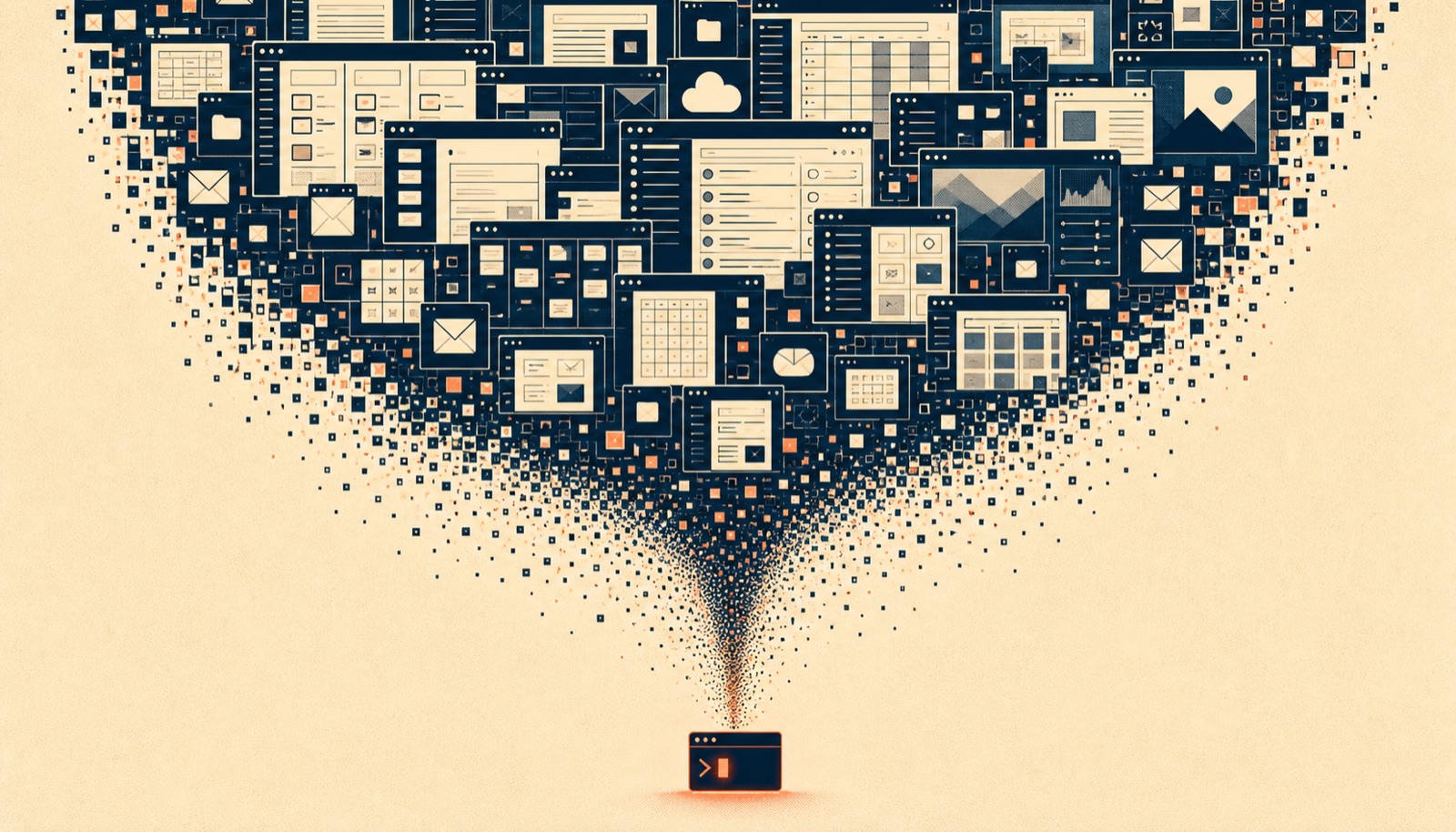
Alright, I'm going to make a claim, and I need you to hear the whole thing before you get mad at me in the comments. Here it is, in three parts:
- Software as we know it — the apps, the suites, the platforms — is going to disappear.
- In its place, AI will generate software on the fly. Interfaces, visualizations, dashboards, documents — conjured when you need them, discarded when you don't. Day to day, you won't click through it. You'll talk to it.
- Which means whoever runs the smartest model wins. Not "has a nicer product." Wins. Business, negotiations, national economies — the whole board.
I say this as someone who has spent his entire adult life building software, teaching software, and getting paid to untangle software. This is going to be one of those passionate yaps, but there's an actual argument here, and I'm going to build it piece by piece. Let's go.
// part 01 — the engine
Intelligence compounds, and that changes what AI can be
First I need to convince you the engine is real, because the whole thesis rests on it.
I think of model intelligence as an interest rate, and every decision a model takes as a compounding period. When an AI does real work — spawning subagents, reading files, editing functions, wiring front end to back end — it takes hundreds of sequential decisions. A model that's 10% smarter isn't 10% better at the job. Every right decision builds on the last one, so after 10 hard decisions you're looking at something 2.6x better, because 1.1 to the power of 10 is 2.59, and yes I did the math, thank you for asking.
# a model that's 10% smarter, over 10 hard decisions
>>> 1.10 ** 10
2.5937...   # not 10% better. 2.6x better.
Now don't get me wrong — this doesn't apply universally. Plenty of decisions are so simple they earn zero interest; hand them to Sonnet, hand them to Haiku, same output. Those are fixed-rate. But the decisions that require deep thinking? That's where it compounds. And with Fable 5 finally released back to the public — I had three glorious days with it before it got banned, and it was absolutely amazing — I've felt exactly what a higher interest rate does over a long chain of decisions.
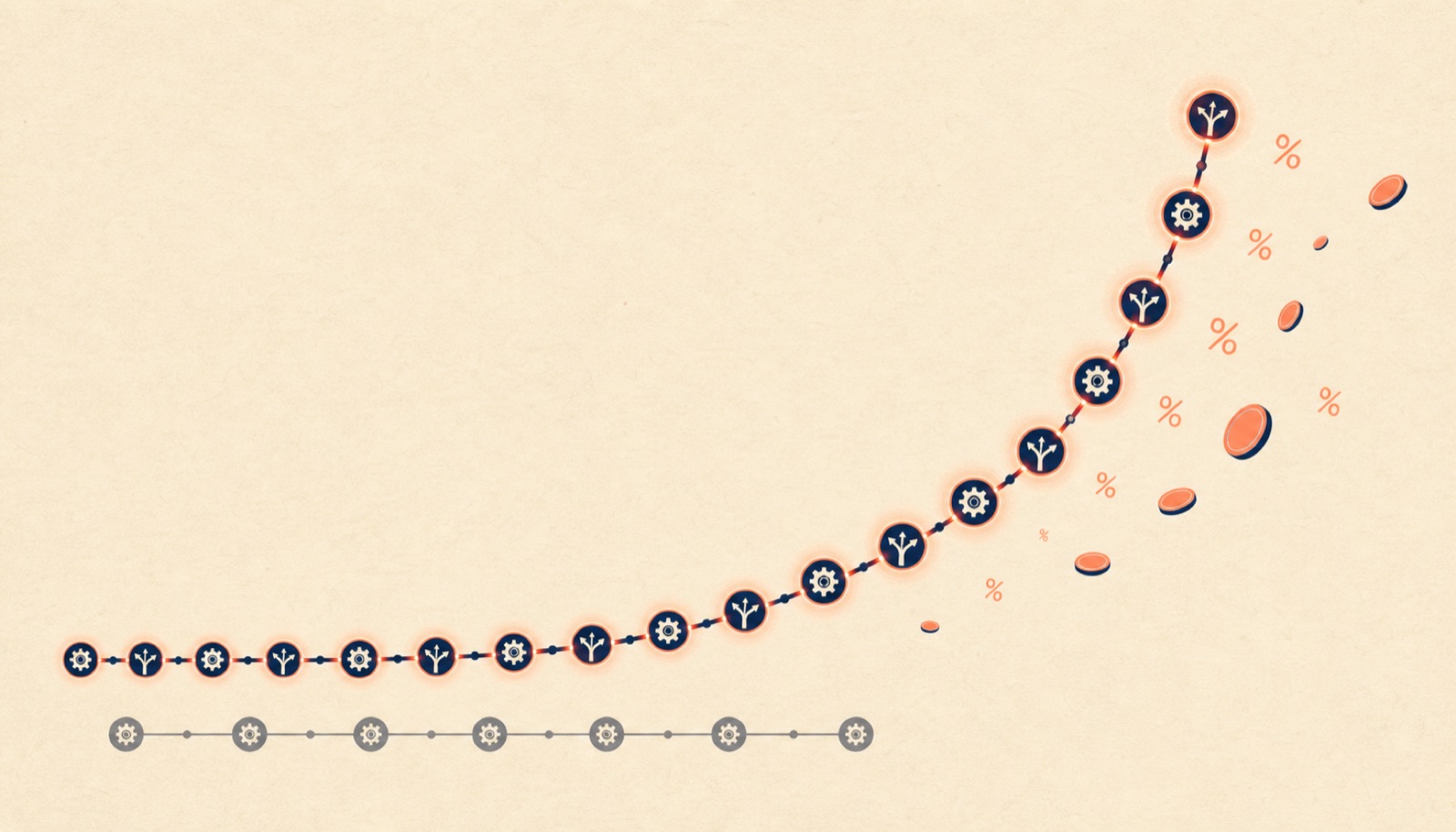
There's a second-order effect too. A smarter model makes more right decisions, so its context — a million tokens now on most of Anthropic's models — doesn't fill up with backtracking and garbage. It works the same problem for longer without compressing itself. And compression matters, because the moment a model compresses its context, it has to wire itself back up and it might miss things. It's like coming back to a hard problem not the next day but the next week, going "okay, where the hell was I?" Smarter model, longer runway, full coherence the whole way down.
Why does this matter for my thesis? Because there's a threshold hiding in that math. Below it, AI is a feature inside your software. Above it, AI is coherent for long enough, across enough decisions, to be the software. We're crossing that threshold right now.
// part 02 — what's being replaced
Most software was never the product — it was a tax
Now let's look at what AI is replacing, because here's the uncomfortable truth about the entire industry: most software is not capability. Most software is an interface to capability, and the interface charges rent in human learning.
I know because I collected that rent. Back at uni I worked as a corporate tutor — companies would send me out to businesses to teach employees their tools. Excel, PowerPoint, CorelDRAW, SQL Server, Access. Excel at its core is a beautifully simple idea — cells and formulas — but mastering it takes years, and entire businesses ran on that mastery. I did work for Qantas in the mid-2010s and their whole timesheet system was Excel files. An airline. Timesheets. Excel. Dummy columns, secondary lookup tables, VLOOKUP surgery on little bits of text — a bazillion rules just to move numbers from one place to another. None of that ritual was the job. The job was "pay people correctly." Everything else was tax.
And the industry's answer to that tax was always more software, in one of two flavors, both bad. Flavor one: small purpose-built apps — intuitive, fast-moving, narrow — that drop you into integration hell, duct-taping APIs together with Zapier, bolting scheduling tools onto Squarespace onto something else, every new tool one more thing to maintain and onboard people into. Flavor two: the monoliths — Salesforce, HubSpot, the Atlassian tentacle-verse — which extend in every direction, sell you add-on packages, and require a small university degree and specialized hires to operate. And above it all, the infrastructure layer: Cloudflare shipping new options daily, Google Analytics hiding features you only find after years inside it, and AWS — a byzantine nightmare of interconnected things that works great and still gets you completely, hopelessly lost in its own console. There's a reason the certifications exist.
Decades of layers of knowledge sitting between people and outcomes — and we put the layers on our resumes and called it a career.
That's the thing AI collapses. Not the capability — the tax on reaching it.
// part 03 — the receipts
I've already stopped using software
This isn't a prediction for me. It's my Tuesday, and I want you to notice what each receipt has in common.
I've built MCP connectors for everything including the kitchen sink — Cloudflare, GitHub, GoDaddy, Mongo Atlas, Mailchimp, Mailgun, Kubernetes. Funny enough, Claude doesn't do image generation in any of its models, so I built a connector that wraps the Codex CLI and generates images through OpenAI's models. The AI that can't draw has a friend who can. (The illustrations in this very article? That pipeline.) And now, when I need DNS modified or traffic analytics checked or a load balancer added, I don't go spelunking through the Cloudflare console for where an option lives. I say the thing I want, and it happens. The console still exists. I just never look at it.
I don't use Excel anymore. I keep raw data — CSV, JSON — and when I need analysis I say "linear regression here," and the analysis appears, with whatever visualization the question deserves, built for that question, then gone. No dummy columns. No lookup tables. No spreadsheet.
I had to raise capital recently, and instead of PowerPoint I had a fully interactive, modular presentation generated — dynamic, modifiable on the fly, mid-meeting if I needed it. Could I have programmed it myself? Sure, I'm a software developer by trade. But it took substantially less time and landed exactly where I needed it to. Word? Same story — most people only ever used Word because enterprise .docx was shoved down their throats, and you can now get perfectly authored documents in any format straight out of an AI, with version control on top.
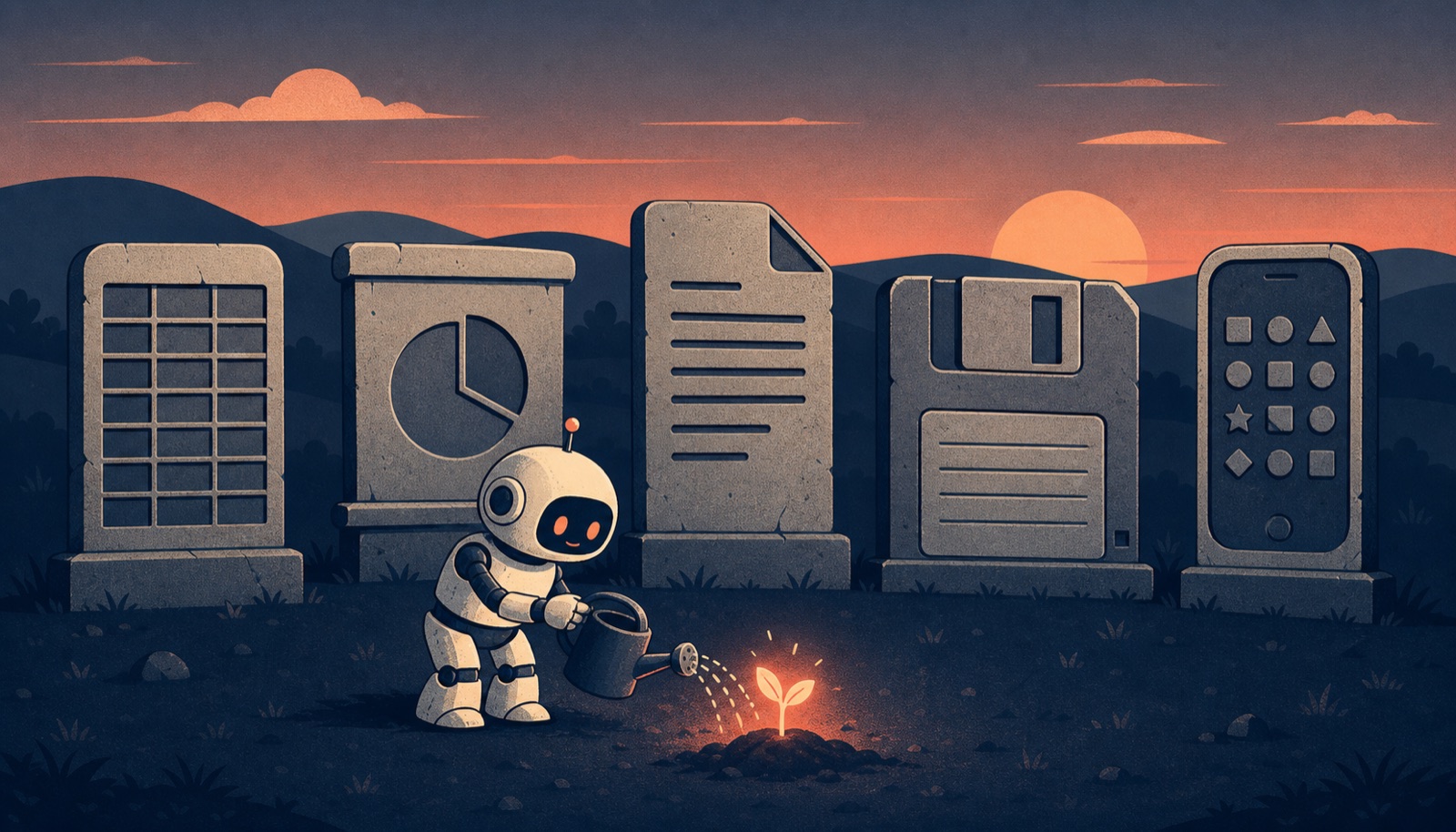
See the pattern? In every single case, the "application" stopped being a thing I own and open, and became a thing that gets generated around my intent and then disappears. The spreadsheet, the deck, the console — they've become ephemeral. That's not "AI improves your workflow." That's software evaporating into the model, one tool at a time. The office suite survives on legacy formats and muscle memory. That's it. That's the moat.
// part 04 — the steady state
Software on the fly, voice on top
So play it forward. If the model can generate the interface at the moment of need, what's the steady state?
It's this: the fundamentals survive, and everything above them becomes disposable. FFmpeg survives — but the video tools that were mostly interfaces on top of FFmpeg don't, because the AI drives the fundamental directly and builds you a viewer if you need one. (Color correction? Not fully there, DaVinci Resolve is still king — but soon.) Amazon SES survives at ten cents per thousand emails — but the Mailchimp charging ten dollars per thousand for logic-and-dashboards on top? The AI builds that logic layer for you. Raw data survives. Open-source engines survive. The bazillion single-purpose phone apps, the Creative Cloud subscription you keep for PDF authoring and the occasional SVG — Fable 5, hell even Opus 4.8, does clean SVGs and diagrams today — that layer melts.
And the day-to-day interface to all of it? Voice. Not because voice is trendy — because voice is what's left when there's no application to click through. You describe the outcome; the AI marshals the fundamentals; if you need to see something — a chart, a schedule, a negotiation model — it generates the visualization on the spot, shaped to the question you asked, and throws it away afterward. Software stops being a product you buy and becomes a behavior of the model. Uniformity dies with it, and honestly, creativity goes up — instead of every company running the identical suite of identical tools in the identical way, different people intelligently conjure different things.
This is also why I stopped building clone products, and it changed my whole instinct as a developer. When this kicked off, my first thought was every developer's first thought: "There's Trello, I can build a better one. There's Mailchimp, I can undercut them." And it doesn't matter. Those tools add no value now — they add noise — because the thing that would make my clone obsolete makes the original obsolete too. Don't build interfaces to fundamentals. The model is the interface.
// part 05 — who wins
Whoever has the smartest model wins
Now put part one and part four together, because this is the part nobody wants to hear.
If software is a behavior of the model, then the model's intelligence isn't a feature of your tooling anymore — it's the productive capacity of your entire operation. And remember, intelligence compounds per decision. A model 10% smarter than yours isn't slightly better at generating your dashboards. Across the thousands of decisions a day it takes on your behalf, it's multiples better. Small gap in the model, massive gap in outcomes.
When both sides of a negotiation show up with AI that models the deal, prices the risk, and drafts the terms — the side with the smarter model is quietly playing chess against checkers.
So the winner isn't whoever has the best product anymore. It's whoever runs the smartest model. That's true for two companies negotiating a contract. It's true for markets. And it's true for countries.
Which makes computation the new premium resource — and I appreciate the irony, because we finally got hardware fast enough that you could host dozens of well-architected systems on a very cheap machine. Computational power was effectively moot. Then AI arrived, massively computationally hungry, and set the whole thing on fire — shortages, hardware prices jumping like crazy. We solved one scarcity and immediately replaced it with another.
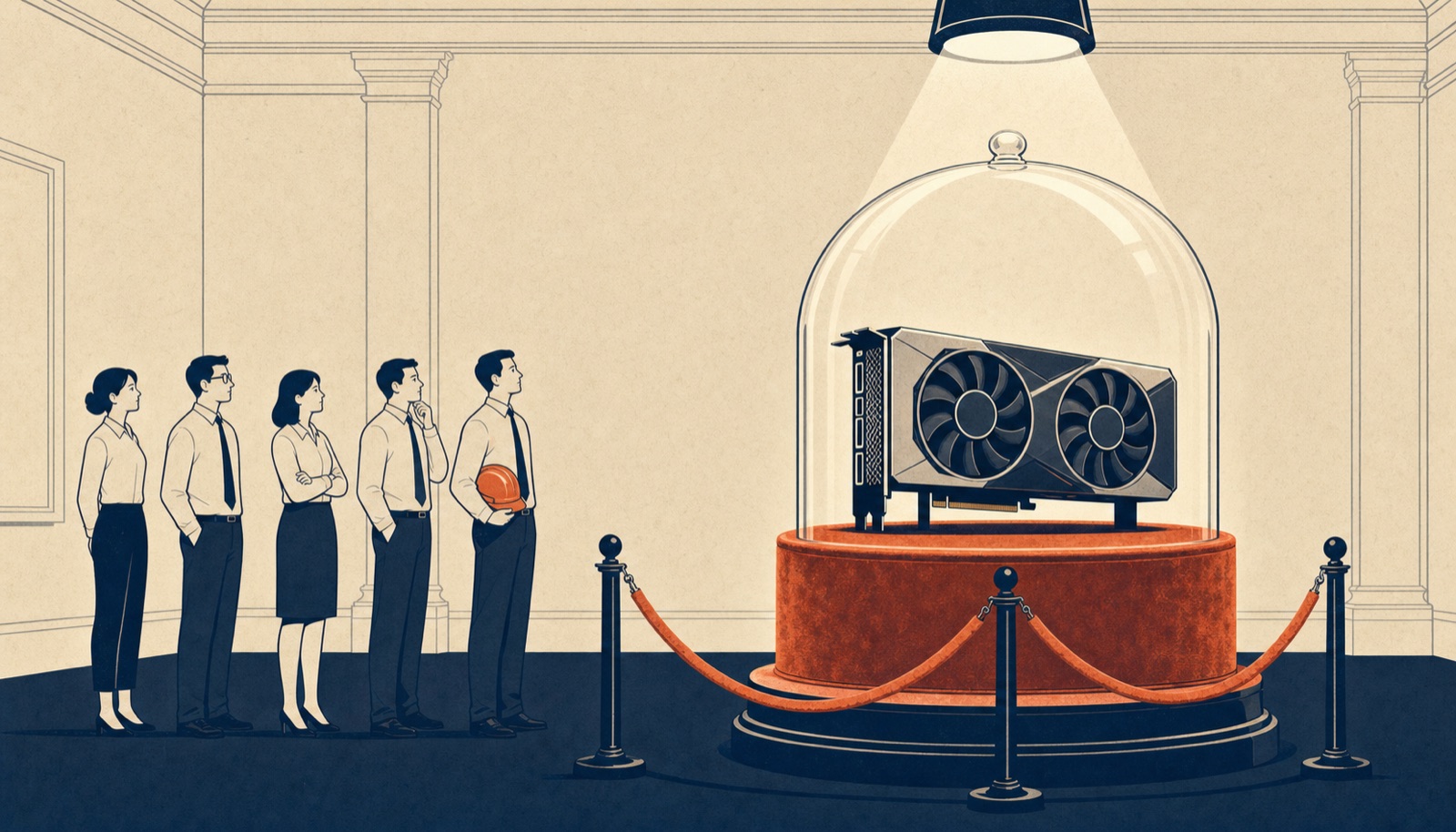
And scarcity sorts people. Here's my prediction, and I mean it seriously. If you do a real, manual, physical thing — sculptor, woodworker, talent in your hands — you're broadly safe; you'll suffer when the economy's bad and thrive when it's great, same as always, because robots are not making robots yet and the tiny robots we can make aren't going to manufacture the big ones. There are layers to this tiramisu. But the white-collar workers without computational power — or the finance to rent it — become the blue-collar workers of the future. That's the inversion.
And the places hit hardest are the ones everyone offshored to — the call centers and dev shops of India and the Philippines — hit twice: once because AI takes the work, again because AI is too expensive to deploy at scale there. I'm on a Claude Max subscription at close to $2,400 a year. For me it's nothing; it helps me so much I don't bat an eyelid. That price excludes most of the planet — and in a world where the smartest model wins, that exclusion is the new class line.
// closing — what's left standing
What survives, and where I land
Not everything melts, so let me be precise about what stays.
Fundamentals stay: raw data, core engines, real capability. Hands stay: the sculptor, the colorist, the genuinely talented Photoshop artist wielding an instrument rather than renting an interface. Humans stay — and get more valuable: royalty-free elevator music out of a garage is over, I'm sorry, when free models on your phone generate thirty seconds of any style you want; but live music, real instruments, real people in a room? That connection appreciates, and we'll need it, because AI arrived right after COVID hollowed out everyone's social lives and there's a real risk we all get very comfortable talking to systems. And purpose stays — the thing that gave me hope, weirdly, was Midjourney going into medical imaging. They started with image generation and pointed the same capability at one of the most painful, valuable problems there is. That's where this is supposed to go, even while YouTube fills up with AI slop that adds zero value and gets its facts wrong.
So, the claim, one more time. The apps disappear. The AI generates your software on the fly and you talk to it like you'd talk to the sharpest operator you've ever worked with. And from that moment on, every business, every negotiation, every economy runs on one question: whose model is smarter?
The interest is compounding. Make sure you're the one earning it.
- whisper_scheduleA recording goes in, a speaker-labelled transcript comes out.Lab
- Semantic food searchSearch food by meaning, not by exact product name.Lab
- Chunk audio with VAD before you transcribeFeeding long silent audio to a transcriber wastes time and money. Split on speech first using webrtcvad, then send only the chunks that contain voice.Snippet
- Voice that never leaves the deviceTranscription, diarisation, and speech running entirely on Apple silicon, and why keeping voice local is a product decision before it is a technical one.Musing
- One voice note, five diariesIn NutriM8 you can mumble your whole day into your phone once. A background worker untangles it into sleep, weight, exercise, hydration and food, and resolves "a snack after lunch" to a real timestamp.Musing